From Ingredients to Experience: Why Cigars Feel Smoother but Are Not Lower Risk
On the evening of May 12, 2024, at a members-only cigar bar near West Lake in Hangzhou, I watched a friend who had just quit cigarettes 11 days earlier light up a roughly 50-ring Robusto. The bar price was 180 yuan, and the staff said "normal pace 55–70 minutes." My friend used to smoke about 18 filtered cigarettes a day — his throat was always dry, and he always coughed a couple of times with his first morning drag. That night he kept telling me: "This stuff doesn't bite, I just swirl the smoke in my mouth and blow it out, it's way smoother than cigarettes, I can get through withdrawal with this." I asked him to hold the smoke in his mouth without obvious lung inhalation, and used a portable breath carbon monoxide tester for a rough measurement: before lighting up, his breath CO was about 5 ppm (a low level after quitting); about 40 minutes in, when the cigar was half gone, it rose to 12–13 ppm; about 15 minutes after extinguishing, it was still hovering around 11 ppm. His subjective ratings were "smoothness 8/10, clean feel 7/10"; but the instrument and his throat and tongue later that night told a different story — at 2 AM he texted me: his tongue was numb on the edges, his nasal cavity felt as dry as if wind-blown, and even after brushing his teeth his mouth still smelled of overnight fermented tobacco leaf.
That night nailed the contradiction I had encountered repeatedly: **the total composition and combustion delivery are not "gentle" — what's gentle is where the irritation lands, how nicotine enters the brain, and the story you tell yourself.** Below I will connect the dots across three lines — composition, combustion, and inhalation method — to explain why it feels smoother, but the risk ledger does not flip to "lower."
I. First, Separate "Smoothness" from Marketing Language
In everyday conversation, calling a cigar "smooth" usually mixes four things:
- **Less irritation in the throat and trachea** (especially when held in the mouth only);
- **A duller nicotine rush**, unlike the seconds-to-brain hit of cigarette lung inhalation;
- **Lower frequency and slower ritual**, with anxiety suppressed by the setting;
- **More complex aromas**, with the brain automatically translating "fragrant" into "sophisticated, clean."
- **Account by session, don't self-soothe with "I only had one today."** Record start/end time, whether lung inhalation occurred, next-day breath, nasal dryness, hoarseness. A 55-minute burning session is not a casual taste.
- **Watch out for dual use.** Cigarettes + cigars is one of the ugliest combinations in the biomarker narrative; it's very common to straddle both during withdrawal anxiety.
- **Treat upper digestive symptoms as signals.** Recurrent oral ulcers, gum bleeding, persistent tongue discoloration, swallowing discomfort, persistent hoarseness — these are not "heatiness" or "cigar culture accessories," they are cumulative mucosal exposure.
- Mayo Clinic: Is cigar smoking safer — tar can be higher, CO and other toxins, full-size cigar tobacco roughly equal to a pack of cigarettes, oral mucosal nicotine absorption even without inhaling.
- Taiwan Health Promotion Administration public education: ~7,000 chemicals, ~93 carcinogens; fermentation and TSNAs; oral/nasal absorption without inhalation; not a cessation alternative.
- Smoke pH / free nicotine / ammonia and nitrate: classic tobacco smoke chemistry (pH rise during cigar smoking, unprotonated nicotine absorption through mucosa); FDA research on cigar subclass ammonia, pH, free nicotine relationships.
- Chen et al., *Cancer Epidemiology, Biomarkers & Prevention*, 2014 — nitrosamine-related urinary markers and serum cotinine multiples in cigar users; dual use even higher.
- Chang et al., *BMC Public Health*, 2015 — cigar use and cancer mortality risk, dose and inhalation depth; elevated upper aerodigestive tract risk even without lung inhalation.
- NCI / CDC public fact pages: cigar smoke contains carcinogens; fermentation nitrosamines; wrapper and incomplete combustion discussions.
These can all be genuine experiences. The problem is: experience variables ≠ toxic dose variables. To separate the two, you must go back to what's in the tobacco leaf, what it turns into when burned, and which mucosal layer it ultimately deposits on.
II. The Ingredient Ledger: Cigars Are Not "Less Tobacco," Often "More Tobacco, Different Delivery"
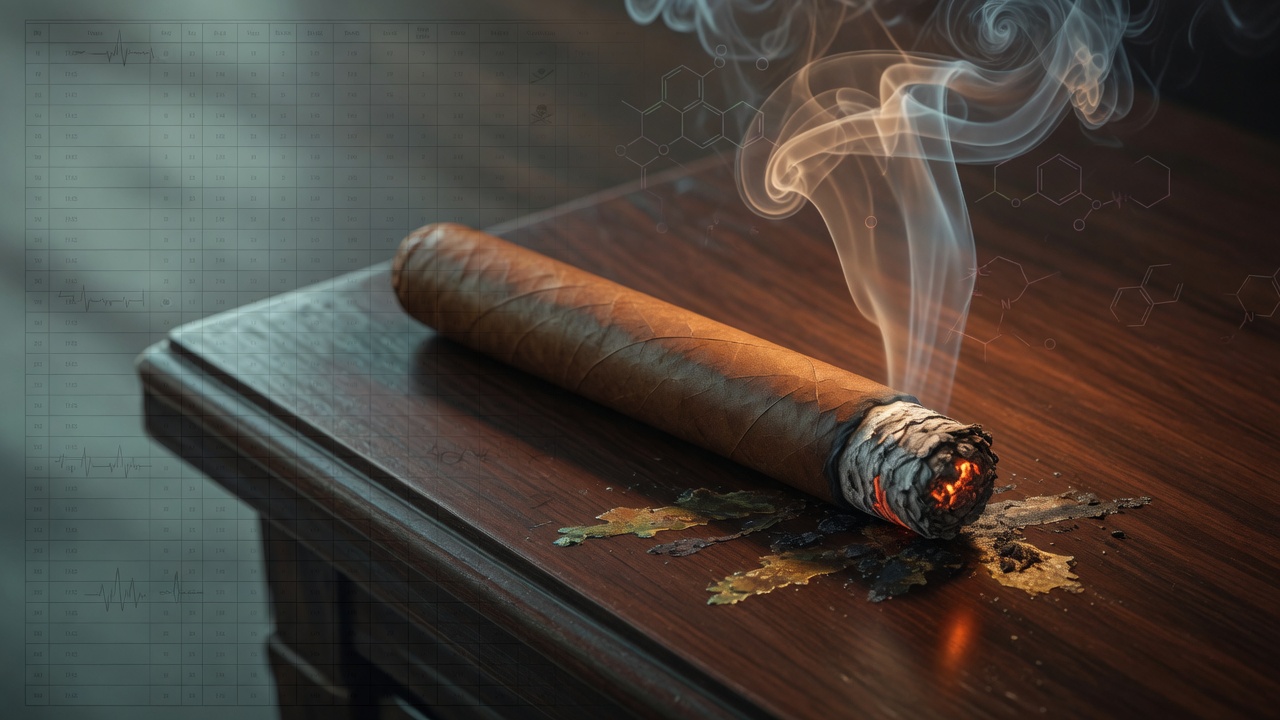
1. Tobacco and Nicotine: A Magnitude Difference, Not a Brand Story
In public medical literature, the amount of tobacco in a full-size cigar can roughly make **a whole pack of cigarettes** (Mayo Clinic and others have written this magnitude statement multiple times). The absorbable nicotine from a single cigarette commonly falls in the range of about **0.1–2 mg**; for cigars, the range varies enormously from cigarillos to large handmade cigars, with nicotine content in the tobacco leaf commonly cited in the range of **dozens to hundreds of milligrams per cigar**. You don't need to memorize any number as a "precise conversion formula," but you need to build the right intuition:
• Cigarettes: high frequency, small size, filter, lung inhalation → steep small-dose pulses;
• Cigars: low frequency, large size, no filter, mouth-hold primarily → prolonged release from a large tobacco column.
In September 2023 at a tobacco and liquor store in Tianhe, Guangzhou, I helped someone who wanted to "transition with small cigars" do the math. The machine-made cigarillos the clerk recommended had a labeled tobacco weight of about 1.2–1.5 g each, with a recommended smoking duration of 10–20 minutes. His plan was "4 cigars a day to stave off cravings." By rough tobacco weight, that was already approaching his former daily intake of 15–20 cigarettes, and on some days would exceed it. The problem he was stuck on was very specific: **not whether he would lung-inhale, but that his daily quota of total nicotine and total combustion products was silently expanding without his knowledge.**
2. Fermentation and Tobacco-Specific Nitrosamines (TSNAs)
Cigar tobacco typically undergoes more extensive fermentation. Fermentation improves ammonia irritation, green/harsh flavors, and smokeability, but public health sources repeatedly remind us: the fermentation process can elevate **NNN, NNK** and other tobacco-specific nitrosamines. These substances are associated with cancer risk in multiple sites including the upper aerodigestive tract — not a byproduct that "craft romance" can erase.
In the public education materials of Taiwan's Health Promotion Administration, cigar combustion products can involve about **7,000** chemical substances, of which about **93** are carcinogens; they explicitly oppose the folk belief of "switching to cigars to quit smoking." To tell fermentation only as a flavor story is to deliberately cut out the toxicology half-page.
3. Nitrate, Ammonia, and Smoke pH: The Chemical Key to "Getting a Hit Without Inhaling"
Cigars commonly use air-cured, fermented tobacco with relatively higher nitrate content; during combustion, nitrogen oxides, ammonia, and other alkaline components are more prominent. Classic tobacco chemistry describes that cigar mainstream smoke pH often shifts from slightly acidic/near-neutral in early puffs to increasingly alkaline (literature shows a rise from about **6.5** to about **7.4–8.0**; cigarette smoke tends to stay in a more acidic range).
When pH rises, the proportion of **unprotonated (freebase) nicotine** increases. Freebase nicotine more easily crosses oral and nasal mucosa into the bloodstream — this is the chemical reason why many people who only hold smoke in their mouth still feel satisfied or even dizzy. FDA research on cigar subclasses also shows that ammonia content, pH, and estimated free nicotine vary synergistically across different sizes; the large cigar end tends to have higher free nicotine.
In plain language: **the fact that cigars "can hit without lung inhalation" is not mysticism — it's alkaline chemistry and mucosal absorption opening the nicotine channel.** An open channel means addiction maintenance capability remains; it does not automatically equal "fewer systemic toxins."
4. Tar and Carbon Monoxide: More Incomplete Combustion, Often Dirtier
Tar is the particulate mixture of incomplete combustion (polycyclic aromatic hydrocarbons, phenols, etc.). Mayo Clinic's public Q&A is blunt: smoking cigars is **not safer than smoking cigarettes**; cigar smoke can contain more tar and may expose users to higher levels of carbon monoxide and other toxins.
The reasons are not mysterious:
• Cigars have almost no cellulose acetate filter, and the wrapper itself is tobacco;
• The wrapper's low porosity and large cigar diameter restrict oxygen supply, making combustion more incomplete;
• The long single-stick burn time prolongs the exposure of mouth and nose to both mainstream and sidestream smoke.
Carbon monoxide's affinity for hemoglobin is far higher than oxygen's (commonly cited as about **200–300 times** in public education). Even if you mostly mouth-hold, there is still some gas exchange through swallowing and oral exposure routes; in a poorly ventilated room, a conversation stretching an hour produces noticeably more discomfort for others at the table than "smoking two cigarettes" — this is a repeatedly observed real-world experience, not a lab-only phenomenon.
III. How Combustion Rewrites "What You Think You Inhaled"
Composition is the raw material; combustion is the printer. The same pile of tobacco, with different peak draw flow rates, smolder intervals, carbon buildup, and temperature recovery, directly rewrites both flavor and delivery.
In January 2024, at a card room in northern China (with only a crack of window open), I observed the same medium-sized cigar under two rhythms:
• **Too frequent draws, too hot**: the smoke instantly turned hot and bitter, the nose felt like it was caked with chili powder, the ash was loose and crumbly;
• **Longer intervals, maintaining even smolder**: the smoke became "round" again, with oiliness and a balanced sweet-bitter return.
Everyone present said the second way was "smoother, more refined." I agree with the sensory judgment, but I reject the conclusion leap — **what became round and smooth were the oral sensory nerves and aroma release curve, not nitrosamines, tar, and CO disappearing from the molecular inventory.** Slow burning may even stretch your session to 70–90 minutes, raising time-weighted exposure, while your brain hands out rewards for the "smooth" experience.
The lack of a filter amplifies this. Cigarette filters trap some particulates and condensate and stabilize draw resistance; cigar smoke goes almost "whole and entire" onto the tongue, soft palate, gums, and postnasal drip area. In April 2022 at a private gathering in Guangzhou, someone cut the cap too deep for a beginner, and within ten minutes tobacco oil was running down the body of the cigar, leaving the fingers sticky with brown condensate. That wasn't "essential oils" — it was the visible form of tar-class mixture. Back home that night, the edge of my tongue coating was yellow, and the taste between my teeth lingered overnight — **irritation had shifted from the lower respiratory tract to the upper digestive mucosa**, and many people misread this shift as "less harm."
IV. Inhalation Method: Mouth-Holding Changes the Map Coloring, Not the Master Switch
1. Mouth-Holding ≠ Zero Exposure
Traditional etiquette encourages holding smoke in the mouth before exhaling. Epidemiologically, exclusive cigar users on average inhale less deeply than cigarette users. The folk conclusion follows: no lung entry ≈ basically harmless.
The real stratification is colder:
• **Nicotine**: oral and nasal mucosa can absorb rapidly; the nicotine reserve in a full-size cigar is often summarized in public education as "one cigar can equal about a pack of cigarettes" — treat this as a **magnitude warning**, not a precise per-person per-use dose meter.
• **Local carcinogen load**: smoke and condensate chronically hitting the oral cavity, tongue, throat, and esophageal mucosa; agencies like the Health Promotion Administration emphasize the link between cigars and risks to the **oral cavity, tongue, throat, and esophagus**, which aligns logically with the "mouth-hold predominant" use pattern.
• **Chang et al. 2015 (BMC Public Health)**: cigar users have higher cancer-related mortality risk than never-smokers; the more cigars smoked and the deeper the inhalation, the higher the risk; **even without inhaling smoke into the lungs**, the mortality risk from cancers of the oral cavity, ear/nose/throat, and upper aerodigestive tract remains higher than that of never-smokers.
2. Former Cigarette Smokers: Muscle Memory Betrays "Just Mouth-Holding"
The second half of that night in Hangzhou was typical: after about half an hour of mouth-holding, my friend's craving and hand gestures returned together, his shoulders dropped, and he made two obvious lung inhales, coughing immediately. The muscle memory built from nearly 20 cigarettes a day doesn't automatically uninstall just because you switched to a more expensive smoke. Literature and clinical observations all point in the same direction: people who switch from cigarettes to cigars are more likely to inhale; when they inhale and use daily, their overall exposure to harmful and potentially harmful constituents can approach that of daily cigarette users.
3. Biomarkers Don't Read Your Self-Rating
Data from Chen et al. 2014 in *Cancer Epidemiology, Biomarkers & Prevention*, frequently cited in Health Promotion Administration public education: those who smoked at least one cigar in the past five days had urinary nitrosamine-related carcinogen markers about **19 times** those of non-smokers; serum cotinine (nicotine metabolite) was about **92 times** that of non-smokers; for **dual users** of cigars and cigarettes, the figures could reach about **191 times** and **1,515 times**, respectively. Specific multiples vary by indicator and population, but the direction is stable — **occasional use, mouth-holding, and the feeling of smoothness do not write "clean inside" on the ledger.**
My personal judgment is direct: inhalation method determines **how risk is colored on the body map** — mouth-holding aggravates the oral cavity–throat–esophagus; lung inhalation pulls the lung and cardiovascular ledger back to full; dual use is nearly simultaneous input on both paths. It is not a harm master switch.
V. Why "Smoother" and "Not Lower Risk" Can Both Be True
Compress the contradiction into four mechanisms, and no slogans are needed.
| Mechanism | What happens in sensation | What happens on the risk ledger |
|---|---|---|
| Nicotine kinetics | Mucosal absorption curve is duller, less of a "bang" than lung inhalation | Dependence can still be maintained; single-stick tobacco reserve is large, session is long |
| Irritation site migration | Less bombardment of trachea/lung cough receptors | Oral mucosa, gums, tongue, throat take on tar and carcinogens |
| pH and free nicotine | Mouth-holding can still produce satisfaction, mistakenly felt as "shallow" | Oral route opens; systemic exposure is not zero |
| Frequency and ritual | One on weekend vs 20/day formerly, subjectively lighter | Product type and use frequency get conflated; once frequency rises or dual use begins, biomarkers turn ugly |
| Combustion and duration | Slow burn is "round," aroma complex | Incomplete combustion + 45–90 minute session, tar/CO/sidestream pressure rises |
In 2021 at a cigar bar in Chengdu, I met a regular who had quit cigarettes for three years and smoked about 2 medium-sized cigars daily. He insisted "my lungs are fine, chest X-ray is clear," but his gum recession and bad breath were the most noticeable things at the table. A temporarily quiet lung image says nothing about cumulative oral mucosal damage, nor about how the cardiovascular and tumor risk accounts will settle over the next decade. **Using the short-term sensation of a single organ to deny multi-organ long-term exposure is the most common form of self-reassurance.**
Let me add one more layer of my own view: what most people are really comparing is not "cigars vs cigarettes at equal doses — which is more toxic," but "my current low-frequency ritual product vs my past high-frequency habit product." When weekly exposure temporarily drops, any substitute will seem "healthier." That's behavioral dose changing, not cigar chemistry suddenly turning into mineral water.
VI. A Consolidated Exposure Ledger (Composition × Combustion × Inhalation)
| Dimension | Typical cigarette path | Typical cigar path | How to read |
|---|---|---|---|
| Tobacco/nicotine reserve | Small per stick, high daily frequency | Can be very large per stick, "one ≈ a pack's worth" of tobacco | Look at session and daily cumulative, not self-comforting stick count |
| Key chemistry | Formulated, additives, acidic smoke common | Fermentation raises TSNAs; nitrate/ammonia raise pH and free nicotine | Chemical basis of getting a hit without inhaling |
| Filtration | Mostly filtered | Almost no filter, wrapper is tobacco | Mouth and nose catch stickier, oilier smoke first |
| Combustion | Cigarette paper more porous, 5–8 min finish | Low wrapper porosity, incomplete combustion tendency, 45–90 min | Double pressurization of tar, CO, time-weighted exposure |
| Inhalation | Mostly lung inhalation | Often mouth-hold, can lung-inhale or dual use | Disease spectrum weight shifts; inhalation pulls toward cigarette risk |
| Sensation | Harsh, fast, frequent | Can be rounder, slower, more ritualistic | Sensation and biomarkers often run opposite |
The Health Promotion Administration and clinicians are highly consistent: **cigars are not a smoking cessation tool, nor a "safer cigarette."** Trying to quit cigarettes by switching to cigars is just swapping one burning tobacco delivery interface for another; oral absorption and longer sessions can stabilize nicotine dependence, and dual use can push nitrosamine and cotinine markers to uglier ranges.
VII. Actionable Takeaways: Don't Use Your Tongue as a Toxicology Lab
If you are using cigars to "bridge withdrawal" or simply trying to understand your body's signals, I recommend at least three concrete actions:
Back to that night in Hangzhou: my friend felt smooth, the instrument showed CO rebound, and later that night his tongue and nasal cavity came collecting. CO is just the easiest line to grab on the whole ledger; TSNAs, mucosal dose, and session duration are written on slower lines, but they still post to the account.
**My conclusion needs no soft packaging:**
The "smoothness" of cigars comes primarily from inhalation dynamics (blunted peak), irritation site shift (lung irritation ↓, oral/nasal load ↑), the alkaline-mediated mucosal nicotine channel, and the psychological relaxation of a low-frequency ritual. Compositionally it often means a larger tobacco column, fermentation-related nitrosamine burden, and more tar and CO from more incomplete combustion; behaviorally, mouth-holding changes the deposition map, while lung inhalation and dual use pull risk back to full. Sensation can lie; combustion chemistry and behavioral patterns rarely do.
A cigar can be a **fully informed personal choice**; it is not a free pass to harm reduction, nor a substitute for smoking cessation therapy. If the goal is to exit burning tobacco altogether, what needs to be replaced is the "combustion-to-nicotine delivery" circuit itself, not merely swapping one seemingly more civilized burning object for another.